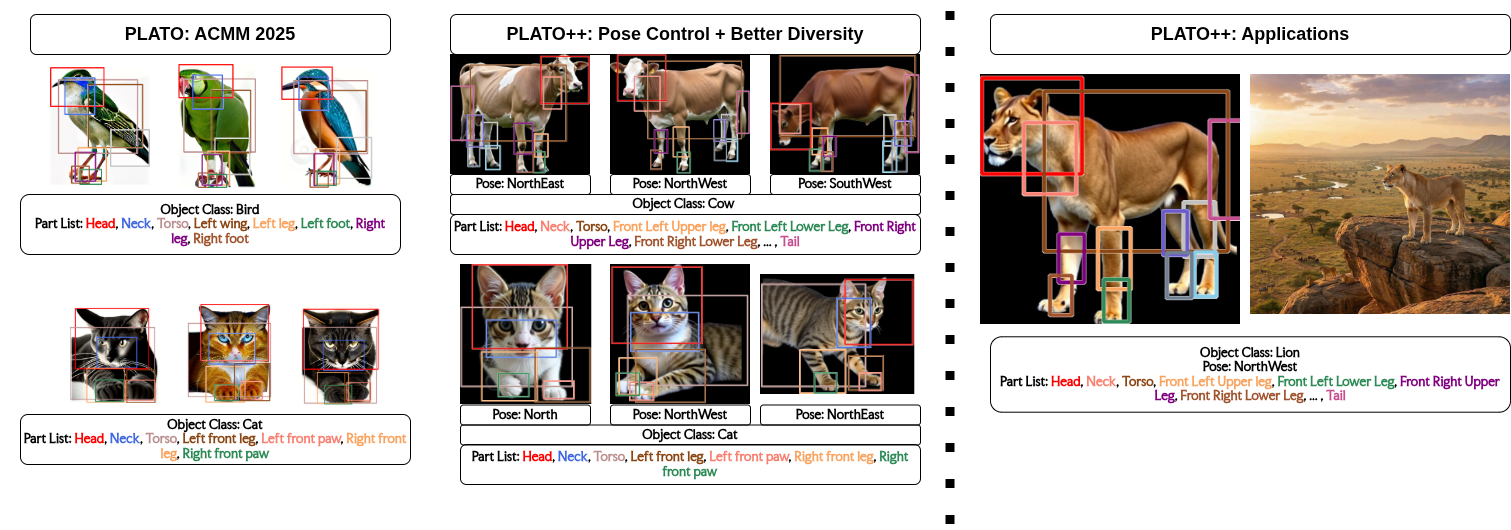
Figure 1. Overview of PLATO++: Our framework disentangles coarse pose control from fine-grained structural synthesis, enabling high-fidelity layout and image generation conditioned on user-specified object class, part list, and target orientation.
While modern generative models produce highly photorealistic images, they often struggle to synthesize articulated objects that follow user-specified spatial configurations. In particular, these models exhibit a strong canonical bias, frequently reverting to average poses or producing anatomically inconsistent structures under uncommon viewpoints. Although recent approaches such as PLATO improve local anatomical plausibility through part-aware representations, they lack mechanisms for controllable global pose generation.
We introduce PLATO++, a two-stage generative framework for pose-conditioned object synthesis. In the first stage, a hierarchical graph convolutional variational autoencoder generates structured part layouts conditioned on the object class, part specification, and target orientation. By learning pose embeddings corresponding to cardinal directions (N, S, E, W, NE, NW, SE, SW), the model produces anatomically consistent layouts with controllable global orientation while preserving fine-grained structural relationships between parts.
In the second stage, the generated layouts are used to guide a layout-conditioned diffusion transformer that synthesizes images consistent with the predicted part layout. Experiments demonstrate that PLATO++ significantly improves pose controllability and structural diversity compared to existing part-aware generation methods, enabling the synthesis of valid layouts and images for long-tail, non-canonical object poses.
A hierarchical pose conditioning mechanism that models pose at two levels: (1) coarse global orientation via discrete cardinal direction embeddings, and (2) fine-grained articulation via continuous FiLM-style latent modulation.
A residual adjacency formulation for graph-based VAEs that models part connectivity as a residual correction to a learned class-specific base skeleton. This stabilizes structure prediction while enabling diverse, non-canonical articulated configurations.
An end-to-end pipeline that converts structured part layouts into a control representation fed to a layout-conditioned diffusion transformer (OminiControl), synthesizing photorealistic images for underrepresented object poses.
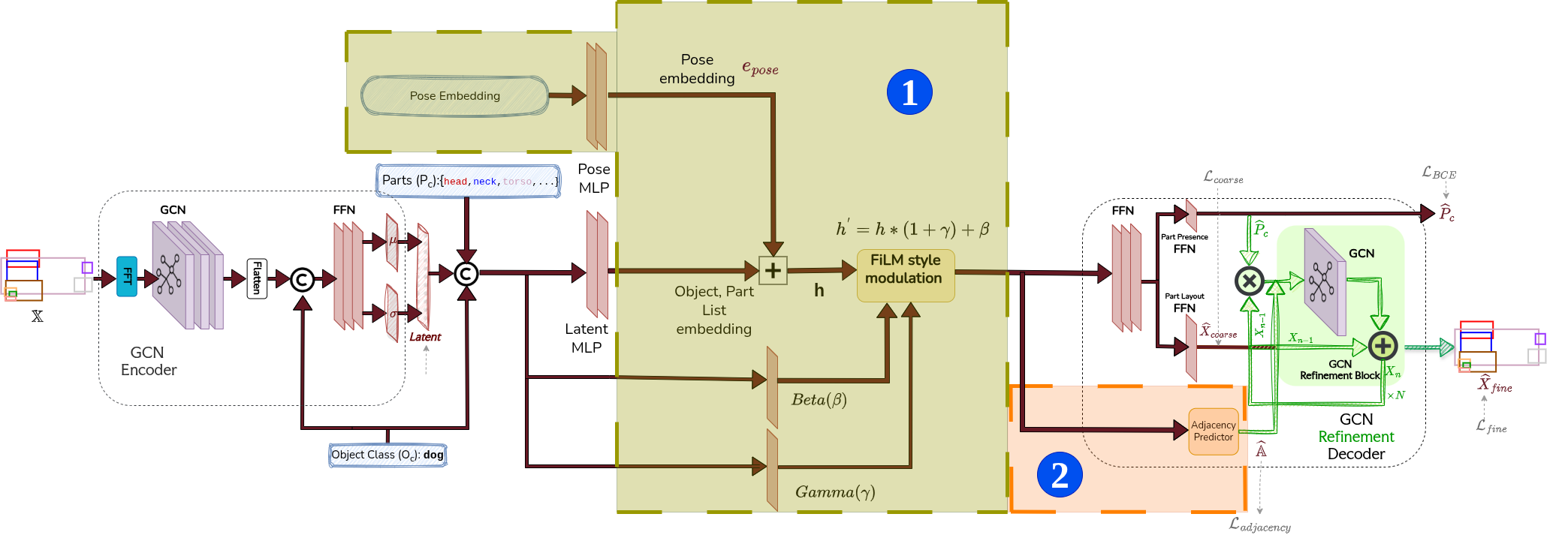
Figure 2. Architecture of the PLATO++ layout generator. Pose conditioning (1) introduces coarse-to-fine control using PCA-derived pose embeddings and FiLM modulation. Residual adjacency prediction (2) enables adaptive part connectivity. A GCN refinement decoder iteratively updates the layout to produce the final structured output.
Stage 1 — Layout Generator: Given an object class, part list, and target pose direction, a GCN encoder compresses the input graph into a latent code. The hierarchical decoder then reconstructs part bounding boxes using (i) pose embeddings for global orientation control and (ii) a residual adjacency predictor for instance-adaptive part connectivity. Gumbel-Sigmoid relaxation with a straight-through estimator allows discrete graph structures to remain differentiable during training.
Stage 2 — Image Generator: The generated part layout is converted into an ellipse-inscribed control image, which conditions a diffusion transformer (OminiControl) alongside a descriptive text prompt. This two-stage design ensures the synthesized image respects both semantic content and structural constraints.
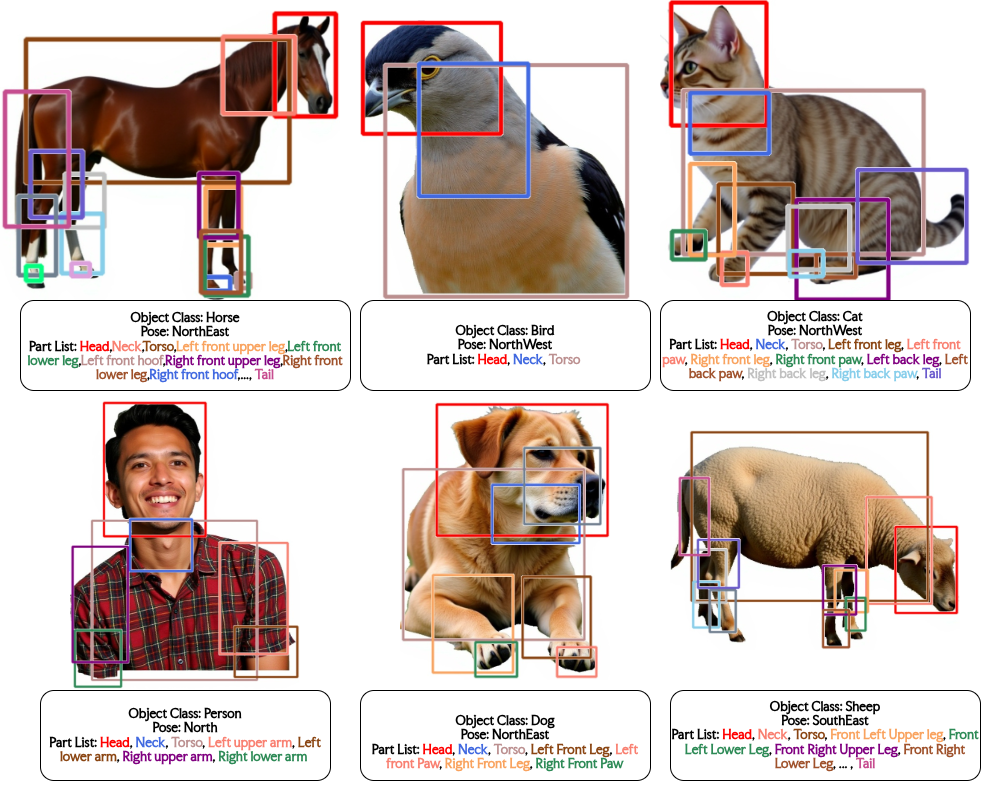
Figure 3. Qualitative results on pose-conditioned generation. Given an object class and a target pose (e.g., NorthEast, NorthWest), the model generates images consistent with the specified orientation across diverse categories. Colored bounding boxes denote the predicted spatial layout of semantic parts.
| Directions | Accuracy ↑ |
|---|---|
| (N, S, E, W) | 77.6% |
| (N, S, E, W, NE, NW, SE, SW) | 61.2% |
Percentage of generated layouts whose orientation matches the input pose condition.
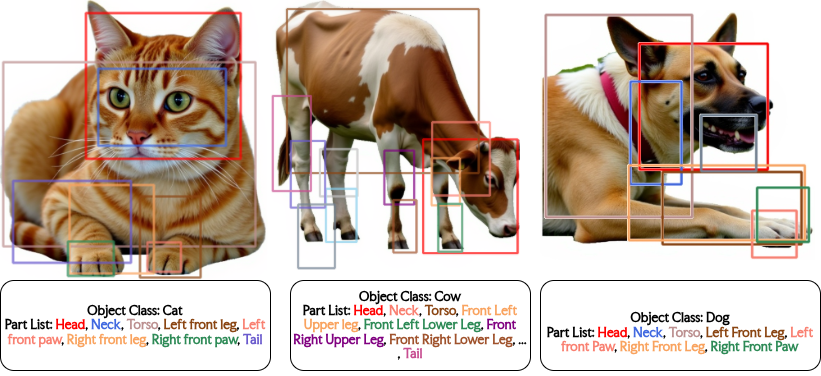
Figure 4. Qualitative results on adjacency prediction. PLATO++ generates non-canonical part interactions (e.g., tail–paw overlap in cats, head–leg intersection in cows) that cannot be captured by a fixed graph, demonstrating the flexibility of residual adjacency.
| Model | mIoU ↑ |
|---|---|
| PLATO | 0.46 |
| PLATO++ (Ours) | 0.57 |
| Adjacency Strategy | mIoU ↑ |
|---|---|
| Fixed Adjacency (Afixed) | 0.47 |
| Full Adjacency Prediction | 0.46 |
| Residual Adjacency (Ours) | 0.57 |
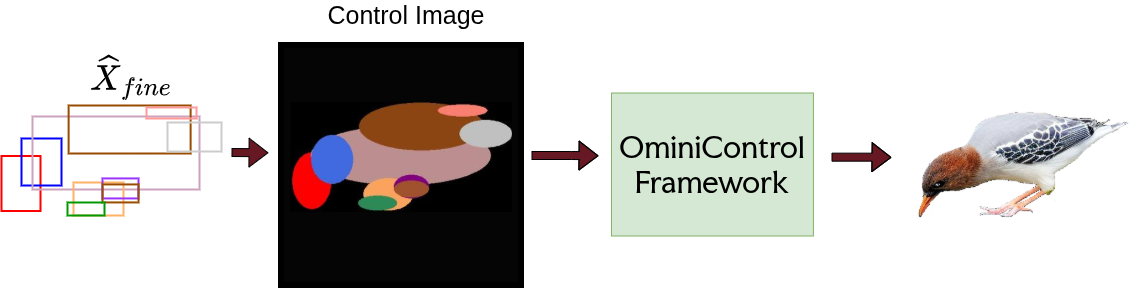
Figure 5. Layout-to-image pipeline. Generated part layouts are converted to ellipse-based control images and fed to an OminiControl diffusion transformer for final image synthesis.
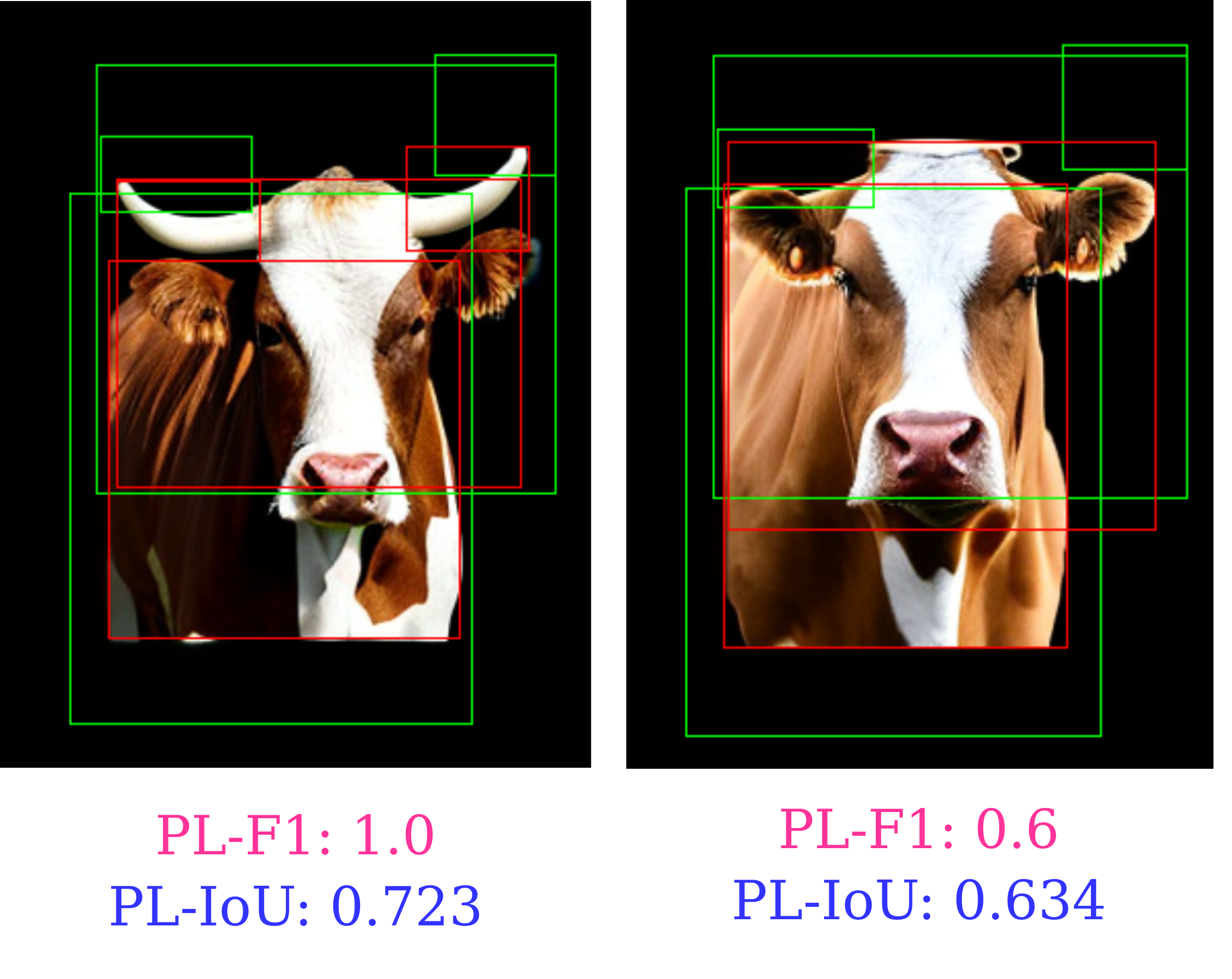
Figure 6. Part-Layout-F1 (PL-F1) and Part-Layout-IoU (PL-IoU) metrics evaluate adherence to specified part layouts. PLATO++ outperforms PLATO on both metrics.
This website is adapted from Nerfies and PLATO, licensed under a Creative Commons Attribution-ShareAlike 4.0 International License.
PLATO++ builds on the PLATO framework developed at the International Institute of Information Technology, Hyderabad.